Nature Blog Network
Showing posts with label CFZ. Show all posts

Thursday, 23 April 2009

A non-cryptozoological trip to Redditch

You should all have by now read Ross’ turn of events regarding last Sunday’s auction. Now, I am not going to attempt to pretend that this was a purely cryptozoological trip, far from it; it was a chance for those who went to get their hands on some great new fish. Ross wanted to get his tanks started with something attractive, but easy to keep; Jon wanted anything with a sp. “something” at the end of its name; Emma wanted some fish for her community tanks; and I wanted both anything with sp. “something” (this means that this certain fish has not been scientifically described, but it is probably from the genus before the “sp.” part. So, Cryptoheros sp. "Honduran red point" relates to an undiscribed cichlid from the Cryptoheros genus, probably from Honduras) and something to sit with a couple of other medium sized cichlids in a 3ft tank opposite my chair to entertain me.

After paying the rather high entry fee, we were given a load of free tubs of food, which we worked out as being worth about £5 more than the entry ticket, so I wasn’t too disappointed. After a quick general meeting (which none of our party had much to say, we were not members), we listened to a talk by Bernd Degen, a Discus breeder and show master for over 30 years. He talked about first showing Discus (with some great photos of the massive Japanese shows) and some of the techniques people use to get that “perfect” discus, then he moved on to a talk about keeping discus in a planted aquarium, something I have always advocated.

After a break, the auction began. The first lot was exactly what I wanted, a 4” male Nandopsis salvini, a medium sized predatory cichlid from Guatemala. This is a stunning fish not that often seen in the shops. When it is, it is usual £5+ for a juvenile about 1-2” long. My male over 8 times that size for £8 was a bargain.

From then on in, our table ended up buying about12-15 lots of fish; I cannot even remember what we got! Emma got hold of her community angelfish and an unusual species of Corydoras catfish, Jon got his beloved Rams (at about half the cost of buying from a shop, and better quality) as well as Aequidens sp. “Peru” (a nice smallish cichlid, similar to the hobby staple the Blue Acara, see top photo); whilst Ross ended up with another undiscribed species (Krobia sp. “red cheek” if you are interested) and various other fish to fill his tanks up with. I got myself a group of Thorichthys sp. 'Mixteco Blue' (see bottom photo) which are currently sat in Jon’s local the Farmer’s Arms. These cost me about £3 for 8 youngsters. This is just plain stupid!

Following from the excitement of the auction, we had Alf Stalsberg, a writer and traveller who was speaking about Aequidens sp. “Silver Saum”. Time for taxonomic cock up! Aquarists may well have heard of a fish called a “Green Terror” (why? Because they are generally a metallic green, and are seriously aggressive). Now, this was thought to be a species called Aequidens rivulatus. This was debunked a good few years back, and the hobby’s fish is now known as A. sp. “Gold Saum” because of the gold edges to the fins. A. sp. “Silver Saum” is very similar, but has silver edges to the fins. Stalsberg went out to collect these fish, and found that these three cichlids represented different species. Now, the Americans (his words not mine!) “walked in and think they know everything!” and said that this was rubbish, A. rivulatus was the species in the hobby, and the others were just geographical variants. Well, says Stalsberg, do variants of a species occurring in the same river system breed only with fish with their own colour edging? No says he, they would all breed together. The fact they he has witnessed a separate breeding divide in the wild proves that they are different species. I for one feel that this argument will carry on for a long time...

After a quick raffle, we went home again to get the fish into their new aquaria. The traffic was terrible and I for one got back about an hour later than expected, but hey, if this is the price to pay for such a superb day, then I would gladly do it again.

Saturday, 11 April 2009

SCORP STORY

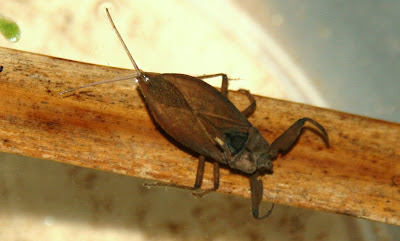
I have a thing for arthropods. I had guessed that you, dear reader, had already grasped that fact, but just to reiterate it, here is the funny tale of just one of Britain’s top tiny pond predators, the common water scorpion.


First, a little taxomony. Water scorpions are insects (ED: no, really Max? Tell us something we don’t know) from the family Hemiptera. A colloquial name for most small insects is a “bug”, but this name is actually the common name for the Hemiptera. Hemiptera are called so because they have two pair of wings, the front of which is very thick and serves as a sort of armour. Hemi= half, ptera=wing. Get it?

As well as the wing thing, bugs are distinguished by having an incomplete life cycle (where the young pass through stages of being nymphs before full adulthood, just like cockroaches, Phasmids, grasshoppers and mantids) and sucking mouthparts. They are known as a “primitive” order because they have an incomplete life cycle, but they still have more than 60,000 species described, more than any other primitive order. They are infact the only inscts to be found in the open ocean (a funny group of water striders, you know, the funny fellows which sit on top of the water in your pond in summer). Some common bugs (other than those mentioned) include: assassin bugs, leaf/stink bugs, backswimmers and leaf-footed bugs.

Water scorpions come from the family Nepidae, which is very similar to the family Belostomatidae, or the giant water bugs. They both fullfill very similar niches in their environment: highly cryptic ambush predators who stalk the upper reaches of ponds, lakes and streams. Both families are always a shade of brown (kinda hard to look like a dead leaf if you are not brown) with large and very stong raptorial front legs. With these they grab onto prey before injecting them with a cocktail of venom and digestive juices, and then sucking out the mush. There are two species of water scorpion in British waters, the common (the short fat fellow) and the stick (the long thin one). I have never seen a stick water scorpion, but the other day I found my first common waterscorpion for about a dozen years.

I am currently wrighting a huge piece of Geology coursework. To avoid it killing me, I try to get out every day if I can. On Friday, I decided to go out to a local garden centre or two to have a look around. Now, thanks to some interesting benefits of competition which I am not going to discuss here, in one place on my route there are two large garden centers right next to each other. In front of the larger one there lie a couple of large ponds. I have never bothered to look at these before, but seeing as I walked right passed one on my way to the other garden centre, I had to take a look. It must have been about 35ft long, 8ft wide, but only 1.5ft deep. There was thick reed growth, but oddly, no other aquatic plants. This made it great for looking into, and in about 3 seconds, I had seen my first newt of the day. A possibly smooth, possibly palmate female. This was followed by about 15 more, so I got bored of looking for newts, and mumbled to myself: “Ooo, this would make prefect water scorpion habitat”. I looked, but to no avail.

Until I moved to a different side of the pond and immediately found one. I was slightly surprised; I have said “Ooo, this would make prefect water scorpion habitat” to myself more times than I can remember, but never seen one, so I thanked the giant water bugs in the sky, and began the tricky process of getting the beggar to walk onto a reed stem so that I could pin it down with another piece and transport it back to the car...

In which I had a plastic bag filled with water and some small snails I had got (for free) from the garden centre. There was nothing for it, I had to take my new fiend home with me in this bag. So I did so.

He is currently sat in a small tub on my desk, and I have managed to persuade him to eat a dead baby cockroach, which bodes well for his future life in captivity. He is living with some small snails and is doing rather well. A handy thing about water scorpions is that they don’t have gills, instead relying on a pair of tubes coming out of their back end to reach up out of the water and breathe. This means they can easily acclimatise to different waters (temperature still remains an issue however) and thus they can settle down in captivity very easily.


What I would really like to have now is a couple of giant water bugs. Forget the inch that my water scorpion is, the larger giant water bugs get to over 4 inches, tha largest even hits 6”, making them easily able to make a meal of newts, fish and very large fat snails. What has this got to do with cryptozoology? Could a giant water bug/water scorpion account for sightings of a huge aggressive preadator that lives in the congo and has been known to take down hippos? Err, no. This story has nothing to do with cryptozoology. But hey, I bet you all learnt something from that tale did you not?

Saturday, 21 March 2009

DON'T BOGART THAT ROACH

EDITOR'S NOTE: It wasn't actually Maxy who came up with that title. I wonder if you can guess what it actually was?

This whole new species in the pet trade thing of mine is coming along nicely. I recently received an order, to be split between CFZ HQ and myself, consisting of 5 undiscribed species of cockroach. These are not cryptids, but they are the next best things; something science has yet to find a name for. They range from being tiny dark brown animals; right up to large showy species which are pretty enough for every naturalist to admire. In this little collection of gems, we have species that are known to species level, but appear to be a new sub-species, those known to genus, and 2 are known to family only. The last two especially are special indeed.

But before we take a look at the different species, let us first look at what the hell a cockroach is. They can be grouped into a couple of “looks”, each suited for a different habitat and mode of life (NOTE: these groupings are not taxologically correct). First we have the large bodied flightless species who spend their time either underground, or under shelter of some sort. We also have the smaller long legged reduced wing species, which lead a more active existence. They tend to run from danger, not fly. The small species with full wings are the most common; indeed, the British species belong to this group. Finally, you have the large winged species. Most of these are partially arboreal, but some become so large that they can no longer fly.


Termites, mantids and cockroaches are closely related, and the name Dictyoptera has been erected to name the group. Cockroaches first evolved in the early Carboniferous period, about 359MYA. Mantids evolved from “proto-cockroaches” about 145MYA in the very early cretaceous. So, as Tyrannosaurus rex was romping around biting chunks out of Ceratopsians, early mantids were munching their way through small invertebrates on a micro level. Proto-cockroaches (or Blattoptera) are cockroach like insects that the true cockroaches first evolved from. Looking at a large cockroaches’ leg, you can see the numerous large spines projecting downwards from the leg. It is not hard to see how these could have evolved into raptorial appendages. Termites are just social wood eating cockroaches. They probably evolved about 120MYA in the Cretaceous from a similar group to Cryptocercus, a small wood eating cockroach. Genetic studies have shown that Cryptocercus shares more DNA with termites than any other genus of cockroaches. It is the only cockroach to exhibit true social behaviors like caring for it’s young. I always find it funny when I say “cockroach” to people, and get a repulsed face. Say mantis or termite to them, and they usually hold them with regard and respect in their mind. You now know that they are basically the same thing.

Cockroaches are best known for being pest insects, which some of them are. But only 25-30 species out of the 4,000 around today are pests. They are generally tough animals, able to survive for a long time without food or water. Indeed, that old myth about cockroaches being able to survive for a month without it’s head is actually true!
In cockroaches, the head performs sensory functions like sight and smell, as well as being the holder of the mouth through which the roach drinks and feeds. Like all insects, the mouth is not used as a respiratory organ, instead they breathe through a series of tubes called trachea. Outlet holes called spiracles on the side of the abdomen open into the trachea, which, like our lungs, feed oxygen to the tissues, and remove carbon dioxide. Large species, with their high oxygen requirement, need to pump their abdomen often to keep air moving through the tubes. Insects also have no brain, they instead have ganglia decentralised throughout the body. Each ganglia controls, say, one pair of legs and acts both independently and in combined movements with the other pairs. In chordates, decapitation leads to death as almost all functions are controlled by the brain. In insects, they will carry on living until starvation, desiccation or predation claim them.

Another myth is that cockroaches will survive through a nuclear war. Well, they will certainly survive better than us, but for an insect, they are nothing special. Most cockroaches have a radiation resistance 6-12 times higher than a human, but animals like flies have even higher resistances. Radiation affects cells only when they are dividing, either by mitosis or meiosis. In humans, cells divide constantly to grow our bodies, repair ourselves or to produce sex cells. In insects, cell division only occurs at ecdysis (skin shedding). Only after they have shed their skin, do the cells begin to divide to quickly grow their bodies before they harden. If a nuclear blast occurred whilst they were hardening, they would be effected. If it occurred whilst the insect was hard, there would be little effect to the insect. However, long-term radiation could hit the insects when they shed, so they are as at risk as us to long-term radiation.

Cockroaches are generally silent animals, but supposedly there is a Floridian species which makes a chirping noise. Better known is the hiss that members of the tribe Gromphadorhini make by contacting their abdomen and forcing air out of the spiracles to create a predator repelling hiss. Members of this group (particularly from the genus Gromphadorhina) are common pets for those with a taste for the unusual, and are often seen in zoos as a handalable exhibit because they are a very large insect that although very impressive looking, is actually very calm when used to being handled. Cockroaches are in fact fairly large for insects. Like mantids, the smallest members of the group are about thumbnail sized (with the average being just above this size), whilst the group contains a very high number of large insects. Some of the largest and most impressive are:

Blaberus giganteus, the giant cave cockroach. At up to 90mm long, this is one of the longest cockroaches. Males are slim and fly well, but females have such massive bodies that the best they can manage is a sort of controlled fall. Males are often aggressive to each other, and both sexes release a very pungent smell which always reminds me of a nice vaguely fruity chemical. A few nymphs of this species usually retail for a couple of quid each.
Macropanesthia rhinoceros is the largest cockroach. At 75mm long, it is not the longest, but it’s sheer bulk more than makes up for this. They can weigh about 35g, which is huge for a terrestrial arthropod. They live for over 10 years and feed on eucalyptus bark and leaves exclusively. They dig and live in deep burrows with networks all around. Males (being larger and with a shovel shaped pronotum) do most of the digging, and the young usually stay in the burrow for a year before they move off. An adult pair of this species can set you back £80!
Megaloblatta insignis is the longest cockroach. At 105mm long, it is a huge beast that has been very poorly documented in the wild. It apparently (and very oddly) mimics larger Blaberus species, but differs in a few areas obvious to a layman, chiefly amongst which, no Blaberus is the uniform brown that M. insignis is. This could be something to do with the defensive chemical I spoke about earlier, but this is just my hypothesis and not scientific fact. This species has not been raised in captivity in the west.

But enough about roaches as a whole, we need to look at the species currently in my care. We start with a species known in the trade as the African Bullet Roach. Why? Well, they are from Africa and move as fast as a bullet! They are a small species getting to between 12-17mm as adults and were first collected in about 1997/8 at the base of Mt. Kilimanjaro in Tanzania. They are so easy to keep and breed that they are being used as feeder roaches for larger amphibians and reptiles. Just run that through your head, an unidentified species, being so common and numerous, that it is thrown to toads without a second glance!


The second species is one that I have yet to photograph properly, due to their small size and fast speed! This is Blaberidae sp. “Kenya”. Notice the “dae” on the end of that name. This means that this species is only known to family level, not even genus (like the above species). Males are an appealing orange colour, but females are a dark brown with reduced wings. They are only small at 10-12mm, but I am really looking forward to breeding them.

Now we look at Pycnoscelus sp. " Malaysia”, a small parthinogenic species (where females can produce offspring without a male) related to the sort-of-pest-sort-of-not Pycnoscelus surinamensis which causes a problem with its size and speed by being able to do well in most conditions (as long as there is a lot of moisture), so it jump’s animal tanks easily. They are tiny, which adults rarely reaching 10mm.


A cracking species is Eublaberus sp. “Pantanal”. This species is related to two common roaches in the hobby, E. disanti and E. posticus, but has much more black on it’s head with paler wings. It is found in a more southerly area than the other two species, and at 50mm, it is longer than the other two species. It is a stunning critter and both nymphs and adults are very showy whilst being rather shy and tending to burrow.


Finally, we have a new colour form of Eurycotis opaca, a large species up to 50mm long. It is related to pest species, but is itself not a pest. It has the build of a running species, but it is much larger than most. Adult’s have a blaze of colour on the pronotum which looks to me vaguely like a setting sun.

I have tried to contact a chap called Darren Mann, an expert in cockroaches, to see if he can identify whether it is worth naming them ourselves, or if they turn out to be a colour form of described species. He is out of office until early April, but naturally, I will keep you updated on developments.
We are also working on a project to try and document the behaviour and biology of these animals involving volunteers from the CFZ readershi[, so watch this space.

Friday, 20 March 2009

Back-dating the Somerset Cat.

On Monday, I went on a field trip. Field trips in Geology are a common occurrence; what better way to learn about rocks than to get out there and look? We were off to a place called Vallis Vale in East Somerset, the site of an unconformity. An unconformity occurs when sediments are laid down, folded so the beds lie at an angle, and then eroded.
Younger sediments form on top of the old sediment in typical straight beds, and an unconformity is created. They are only visible when falling sea levels and colliding continents cause the unconformity to rise above “normal” ground level.
Cutting by a river or quarrying also helps. You can see in the photo the different dips of the beds. The beds themselves can be dated by looking at the fossils within them; the rock below is from the Carboniferous period, and the rock above is from the Jurassic. This site is geologically important as it was described in the world's first Geological Survey memoir in 1846 and helped establish the science. Anyway...


In the minibus on the way up, through the sounds of Rush’s “2112”, I overheard my teacher talking to the lad sat in the front seat that he had seen a “black panther” crossing this road at night. I realised where we were, and found that we were about 800m from the field in which the big cat has been killing dozens of sheep! Hooray!

The next day I stayed behind to ask him about it. He said he had been driving along the road at about 2145 to take his son’s babysitter home, when out of a wood on the left this Labrador walked out onto the road. He stopped to see if it was ok (clearly a dog walking around on its own is a cause for concern), but it suddenly dawned on him that it was a big cat. He stopped the car and watched the cat watch him. It carried on it’s way to the right, and he can remember clearly pressing the button to wind the window up; just in case.

He also said that his first encounter of big cats (or rather, something) happened at around the same time when climbing in Cheddar Gorge. He was getting up to the top of the ridge in an area where no people go because it is very heavily wooded. He got to the top of the ridge, and found an area of scraped ground with a large mound of foul smelling dung deposited inside. He didn’t recognise it as being something he was familiar, but he left it due to the difficulties in getting it back down again.

My teacher is not unknowledgable when it comes to animals; parts of teaching geology necessitate a good knowledge of the natural world, and I would take his account as highly credible. The diagnostic features he remembers are; very long thin tail, jet black colour (“such that if it was hidden in bracken or a ditch, you could come within 3ft of it and not notice it was there” he said), slightly pointed ears and a very calm demeanour. It’s total length was about 2m long.

This is all very interesting, but there was one more thing. The sighting happened 14 years ago.

Thursday, 12 March 2009

Walking in a Winter Wonderland

Back in early February, as I am sure you remember, the British Isles had a flurry of snow. Here in Somerset, we had our fair share, and I - being the good field-man I am - went up to the usual place to see if Mr. Kitty had left any traces of his existence. The farmer had moved his sheep away into shelter over the cold snap, so I knew that there would be no new kills to poke.


I battled my way up to the field, parked up, got out and had a look around. I was extremely surprised to see the amount of snow prints I did (nothing feline though), and got round to the fun business of identifying them all, as all good naturalists should. Now, I know what most of these are, but the real question is, do you, the CFZ blog readers, have any idea what these prints are from? The person who sends in the most accurate answers as to what the following 8 photos show wins a year’s subscription to either The Amateur Naturalist or Animals & Men magazine, it’s your choice! Answers can be sent to max@cfz.org.uk. The number at the end of the text next to the photo shows the question number.


First up, we have this image. Any ideas? They are right down to the ground (3”), so we must be dealing with something with fairly small feet for its body size.


The two prints are about 6” apart, and each print is 1.5” wide. Claws are clearly visible, which are short but thick. The central pad is also diagnostic. [1]


Ok, now try this. We have two prints, which plunge very deep into the snow with a pretty large amount of kicked back snow. The prints are about 1-1.5” in diameter, and are about 1’ apart. [2]


Moving briefly to a photo I took near my house, what have we here? We have thinner snow, maybe an inch, with two sets of prints. One very large long one and two smaller distinct prints. The prints are about 2” wide. Any ideas? long one and two smaller distinct prints. The prints are about 2” wide. Any ideas?


Moving briefly to a photo I took near my house, what have we here? We have thinner snow, maybe an inch, with two sets of prints. One very


[3]


And this one? An odd one this. The snow is very thin here. [4]


And this? Four points originating from a central source. [5]


Right, let’s get tough. The next few photos are fairly indistinct, and I won’t be adding my suggestions and hints for any of these. Good luck!


[6]


[7]


[8]


Oh, and just for fun, this is the amount of prints that you get around a decaying carcass as scavengers, errr, scavenge for meat left on the bones.


Wednesday, 11 March 2009

An opossum's tail

Opossums are a group of about 90 different species occurring only in the western hemisphere, occurring from southern South America right up to Canada. The most famous species is Didelphis virginiana, the Virginia opossum. It looks vaguely like, and is usually portrayed as being, a giant rat with a fluffy coat, when actually it is a marsupial that happens to benefit from human habitation as it uses houses for shelter and food (scavenging for scraps) in the same way that rats do. I guess it’s partly hairless tail doesn’t help its cause...

Possums are a group of about 65 different species occurring in Australia, Sulawesi and New Guinea. The most commonly encountered species is Trichosurus vulpecula, the common brush-tailed possum. At a maximum of 4.5kg, it is not far off the above species in size, but it’s bushy tail, shorter muzzle and darker colouration make it easy to tell apart. It too likes people’s houses for the same reasons, and usually it causes an annoyance for people who have to sleep with them running over the roof every night.
Now, although there is only one letter different between “possum” and “opossum”, apparently this causes a problem for some people. Google for instance, throes up dozens of photos of both possums and opossums when you google “possums”, mainly of D. virginiana. Why on earth does this species have the common name of “possum”, when it is nothing of the sort?

Unlike other common name confusions, which are usually due to visual similarities between species, D. virginiana looks very little like a, for instance, T. vulpecula. It must then be pure and simple laziness which causes people to mix the two names up. Why bother to say “opossum” when you can say the easier “possum”? Waste of time innit? Whose gonna care ‘bout one letta?

Hummm.

The catalyst for this short rant is a video (http://www.weebls-stuff.com/toons/Australia/). Although very funny, and the vocals say “possum”, they cock it up by depicting a very rat-like D. virginiana with the long muzzle and nearly hairless tail. Oddly enough, the idea that possum attacks are the “number one reason for a day off” is, according to an Australian friend, complete rubbish, mainly because they only attack people in extreme circumstances. But how hard would it have been to google “possum”, looked in Wikipedia or whatever site first comes up, and found a representative possum from Australia?
Again, why bother? What’s Joe Public going to care? Well, if I had my way, they damn well would. I bet even 8yr old me could have told you the difference between possums and opossums. Why not everyone else?


Saturday, 7 March 2009

A picture's worth a thousand cryptids (OK that headline is completely meaningless but Jon thought it up, and I have to humour the old chap)

For this evening/morning/whenever you read this you are going to be talked at by me about the importance of photography and being a naturalist.


Digital photography is quickly becoming a very mainstream pastime. No longer do you need to faff about with darkrooms and expensive films; a simple household computer is all you need. The advantage of the technological revolution is that equipment drops rapidly in price over time (just look at widescreen televisions; you can pick up a 32” LCD TV for £500, a couple of years ago they were over double that!) whilst the quality of the goods increases (you can look at digital cameras this time). So, we are getting double benefits: prices for goods are dropping as the goods get better and better. It’s a great situation to be in, and with the current recession reducing demand for luxury goods (cars, for instance, have seen an unprecedented 35% drop in demand this year compared like for like to last year), if you can afford to buy a good digital camera, now is the time to do it!

In this series of blogs (yes I know, I should be following a trail of dead sheep, but the famer has moved them indoors for a while, so the cat has buggered of elsewhere), I will be looking at what to look for in a digital camera, if you are a naturalist. I could talk at great length about D-SLRs (digital single lens reflexes), but for the moment I am going to discuss more affordable options: entry level cameras.


In the above photo, the black dots are starlings.

A basic camera will set you back about £100 (roughly) and will probably have a 3x optical zoom, still and video modes, about 8.0 megapixels, a macro mode and a fairly large screen. A 3x zoom is not exactly superb, but all the other features are essential for a naturalist. Still and video modes gives you flexibility when shooting without needing two separate cameras, 8.0 megapixels allows you to produce a fairly large image which can be printed out at a later date up to about an A4 size, the large screen allows you to clearly focus on your subject, whilst the macro mode allows you to take clear photos of small flowers/invertebrates. These cameras are usually pocket sized, and are very easy to carry around in a pocket or handbag, and are aimed squarely at beginners, or people who don’t want to fuss around with photography.


Most of the settings are automatic, and there is usually a small manual override on some settings, but usually very little. A large memory card is essential to make sure that you have enough space for images, no matter what happens. So, if you do see that elusive big cat you have been chasing for ages, you want to be able to keep taking photographs for the full duration that you can see the animal and not have to worry that you are going to run out of space on the memory card, which will prevent you from taking any more photos. You don’t need expensive aftermarket image enhancer programs either. Windows XP/Vista (and I assume its equivalents) comes with a “fix” tab in the image viewing screen. It is not fancy, but if you are shooting at night you can enhance the brightness to pick out any figures in the gloom. You can crop the image in the same way.


Cropping cuts out a piece of the image to allow you to take out areas outside of the subject to enhance the look of the image. You can also use it to show a particular far away object in a better zoom, letting you, as I said earlier, determine between a bustard and a goose.

If your budget will stretch to it, a camera with a better optical zoom is a good investment for obvious reasons (to look at Jon’s article the other day, a bigger zoom allows you to see if it was a bustard or a goose when you look at the photo afterwards). Some manufacturers will con you by telling you the digital zoom. This is something quite different to optical zoom (where lenses move inside the camera to zoom), where the camera zooms in digitally on the image. It gives the impression of a bigger zoom, but when you look at the photo on the computer, it will probably be very grainy. You could get exactly the same results by cropping the image from your computer.

Beware however, as you move up from the beginner’s pocket sized cameras, the need to incorporate more space for lenses to move necessitates the need for a larger lens, so the size of the camera tends to increase from this point onwards. But, these more expensive cameras come with customisable features, allowing you to fiddle manually with things like ISO, exposure settings and white balance to produce more tailored images. Image stabilisation (helpful for shooting fast moving objects, or when you are moving) is also a very handy thing to have.

But why am I taking the time to talk to you about photography in a zoological blog? It is because I have a dream.

A dream of a day when everyone, interested in zoology or not, takes a camera with them everywhere they go. How many more photos of cryptids would there be if everyone took a camera around with them? The quality of cameras is rising rapidly, and their use to naturalists is increasing. I find myself wanting to kick people after I talk to big cat witnesses when I realise that although the big cat is a regular in their area/field they never thought to bring a camera with them. A not insubstantial amount of big cat sightings are made face to face with the cat as both sides stare at each other in surprise. Meetings like this can go on for minutes on end, think of how many photos you could take in this time! Even if the first photo wasn’t brilliant, you would still have lots of time to tweak the settings for a better next shot. Why on earth don’t people do this! One of the best ways to prove something’s existence is to photograph it; for the price of one piece of hardware. A small price to pay methinks.

Plus of course, cameras are kinda nice for photographing the kids growing up, family events or holidays. Talk about killing two birds with one stone...


Thursday, 12 February 2009

The CFZ solves another mystery!

And then, as if by magic, just when I had finished writing the previous blog, I got an email from a contact from the local news who said “One of our readers e-mailed me these this am. I’ve had a long chat with her and she is convinced they are a big cat’s prints. She heard a big “kerthump” as if it was jumping down. She has fields and woods around her and just three houses up there. Lots of deer in the fields. She is on the Cranmore side of Doulting. I said I would pass the photos on to you to see what you think. Her details are below and she is happy to talk to you. I have sent her copies of the stories we did as she had not seen them.”.


Attached were two photos, one showing the print, and the other showing the stride length. They looked pretty damn canine to me, but for a second opinion (always important) I passed them (again) on to Richard Freeman, who had this to say:

"These are clearly dog tracks. The concave shape of the main pad can be seen in the first photograph. Also, the toes are symmetrical and show the blunt claws of a canid. A cat's claws are finer and only seen in prints when unsheathed for a firmer grip on slippery or uneven surfaces. A cat's main pad has three bulges or lobes akin to the shape of a club in a deck of cards. The toes on a cat are asymmetrical unlike a dogs."


I don’t think I can add anything to that! Never mind, at least the CFZ now has a very good photo of what a dog’s print in the snow looks like!

I did have chat with the person who took the photos, and the fact that she lives next to a field in which a few dogs are walked closes this case. Apart from one thing: “She heard a big “kerthump” as if it was jumping down.”. This does sound a bit odd, until you realise that the prints were in her garden, and to escape the dog would have had to jump over the fence, creating the “kerthump” noise. Case closed.

But, the journalist who sent me this case also mentioned that she is “trying to check out the report from the lady from Cranmore who was saying she heard something big snarling in the bushes near her home last month.”. Now, as you can see, Cranmore is very close to the place where the lady found the dog prints. Naturally, I will keep you updated.

Wednesday, 11 February 2009

Cat prints? Not again...

It is now time to update on the hunt for alien big cats in the UK. Last time, you will remember I was told by a member on an invertebrate’s forum that her boyfriend had taken a cast of the print of an ABC, or so her other half’s mate said, in their local area. Naturally, I asked; “where is it now?” and the reply was “I don't think he has the cast anymore”. “Bugger!” thought I. Never mind, she sent me a link to a photobucket account where there were photos to look at instead. They looked like a good match for a cat to me and the size was well within big cat range. After forwarding them to Richard Freeman, I emailed Hollie, as her name turned out to be, who gave us permission to use the photos, and it is to her that I am very grateful for otherwise this extra evidence would not have come to light. The best photos are shown below.


Also, she said that her boyfriend (Dan) had “actually seen the cat one night when hunting up there, though it was it dark he says he remembers seeing a big pair of eyes, too big for any "normal" animal, and looked orange coloured apparently.”.

Now, it is time to explain this eye shine business. Eye shine is, obviously, caused by light entering an animal’s eye, reflecting out of the animal’s eye and then entering our own. The shine effect is from a layer of tissue called the Tapetum lucidum which is found in many vertebrate animals. Its function is to reflect light into the light sensing cells (Rod cells) in the eye to enhance night vision further. So, when a light is shone into an animal’s eye, you quite often see it shone back at you from their eyes as the light escapes from the lens and through the pupil. Carnivores possess a choroidal tapetum cellulosum which is made of reflective crystals, whereas artiodactyls and perissodactyls have a choroidal tapetum fibrosum made of extracellular fibers. So, these two different reflective layers give different eye shines.

Eye shine varies between different animals, but it is not an exact science. Cats usually have green eye shine (domestic), as do deer, but dogs can vary from green to yellow and to orange, depending on breed. However, a number of reports say that big cats like leopards have orange eye shine, which completely confuses the matter! I must say this subject has been hard to research; everything contradicts everything else!

Then, as if this wasn’t good enough, Hollie spoke to her boyfriend, who said that his mate still had the cast, and that we were welcome to have it for a bit! This is excellent news, so we will have to sit tight and wait for Pat.

In the mean time, Richard got back to me to say this:

“Though I will reserve final judgement until I have actually seen the cast my initial feelings are that these are indeed cat prints. The toes are asymmetrical and lacking in visible claws. The central pad lacks the concave shape of a dog’s .The toes also appear to show greater flexibility than a dog's.”

He attached the following photos; the uppermost photo is of a leopard, whilst the other is of a puma’s print.


Now compare these photos to the cast photos above. Richard says:
“It could belong to a puma or leopard but I think it is most like a puma's with the wide toe pads. In fact the print reminds me of a Florida puma print I saw that had been cast from a track left in sand.”

I agree with him, but also the central pad in a puma is more compact than a leopard’s, very similar to the print in the photo.

For a further analysis, we will have to wait for the print to be delivered. Watch this space with bated breath! But may I just say again how grateful I am to Hollie for letting me look at the photos and for doing her best to help find the cast. If only everyone came forward with evidence!

Monday, 9 February 2009

UK ALIEN ANIMALS STUDY GROUP: Never outfox a fox

There seems to be a theme running threough the CFZ. After Beth's post about her pet fox Millie, we had Tim’s post on urban foxes, Dr. Holdsworth’s post on their biology, and now we have me looking at a very interesting alien animal indeed, the wily fox.

Vulpes vulpes is the UK’s local fox. The genus contains 12 species who are to be found on almost all continents (Antarctica is, as usual, an exception) and they all fill the same role: small adaptable carnivores who are adapted to eating any animal from the size of a typical insect, right up to a large game bird or lagomorph. Foxes moved up from the land bridge from Europe into the UK, but they never got up to the small islands off the coast of Scotland. However, it seems they may well have found a way.

Thanks to the very helpful Glen Vaudrey, (soon to be CFZ Cheshire rep) we have the news that it looks like the red fox has found its way to the Outer Hebrides. Although no reports have been certified by Scottish National Heritage, between December 05 and January 07, with 2 reports before this, 12 reports of foxes have been reported. These come from the Islands Lewis, Harris, Benbecula, and South Uist. I did try to upload an image of the area, but it was too small to see the Island's names, so I have not. But, the reports nearly span the entire area of the Outer Hebrides, from Lewis in the north to South Uist near the South. The sheer span of reports is what settles this matter for me; we have sightings of adults, sightings of cubs, 2 reports of droppings, a dog who acted strangely in response to smells, and finally, that a fox was seen for 15 minutes by a professional mammal biologist. The reports I was sent are repeated below:

Dec-05 Tolsta, Lewis = Report of fox seen on croft
Dec-05 Gress, Lewis = Report of glimpse of fox by road side
18-Feb-06 Urgha, Harris = Report of fox watched for 15 mins by professional mammal biologist
2005 Barvas road, Lewis = Note on local paper about someone seeing a fox cross Barvas road
2005 Clisham, Harris = Letter in Stornoway Gazette reporting seeing fox cubs beside a loch
28-May-06 Tong, Lewis = Report of fox seen in garden
May-06 Galson, Lewis = Report of fox droppings, and a dog behaving in a strange manner in response to smells
06-Jun-06 Daliburgh, S Uist = Report of fox seen crossing road in the evening
06-Jun-06 Liniclate, Benbecula = Report of fox
27-Jun-06 Tolsta, Lewis = Report of fox droppings by Garry Bridge
Aug-06 Uig, Lewis = Seen on road somewhere between Gisla and Grimersta
31-Aug-06 Arnol, Lewis = Seen near fish farm
Dec-06 Gress, Lewis = Seen on a croft
Jan-07 Aline, Lewis = Fox seen in trees by the road

This is a lot of reports, most of which seem viable. As one would expect from foxes, there are reports from a number of different areas, notably including a garden (typical!). 10 of the reports predictably come from the largest Island, Lewis. Now for the real question, how did they get there?

Tough to answer that is. If this was a geological report from 3 million years in the future, and we were looking at fossils not live animals, we could confidentially say that they got to the islands by using the sea as a vector and were washed out to sea, possibly via a flood, where their swimming and the action of the current swept them over to the islands.
The distance from the Inner Hebrides to the Outer Hebrides, is about 25kms, not too far for animals to be swept. This may have taken a few days and a lot of luck, but the fox may well have got there still breathing. Thin, but alive. All it would take is a male and female to be washed up within a few years (their lifespan is only about 3 years in the wild) and you probably have a breeding population. Better than that, a pregnant female is washed over and then you have multiple foxes.

However, we are not dealing with geological time; this is “real” time. I am not so sure that this a long enough period of time for this theory to work, although we must not dismiss it. It seems that humans are a more likely vector, either deliberately or by accident. They could have been released by someone bringing a few over from the mainland, or in the hold of a ship. I am really not sure what to make of it! David MacLennan from Scottish National Heritage says “It’s very difficult to say how they got here, because we don't even know if they are here!” and I must say I agree with him in the main. It seems highly probable that they are there, but more evidence is required. Photos however, are to easily faked by photographing a fox from the mainland, so a pinch of salt may be required if one comes to light.

WIKIPEDIA FACT FILE: Today, the Red Fox has thje widest range of any carnivore - range spanning most of North America and Eurasia, southern Australia, and with several populations in North Africa. In Australia the Red Fox is an introduced species and a serious conservation problem. Introduction occurred about 1850, for recreational fox hunting, In North America the Red Fox is native in boreal regions, introduced in temperate regions. There is a recent fossil record of Red Foxes in boreal North America, and one subspecies of these native boreal foxes extends south in the Rocky Mountains. In temperate North America, Red Foxes are derived from European Red Foxes, which were introduced into the Southeastern United States around 1650-1750 for fox hunting, and from there to California for the fur trade. The first introduction is attributed to Robert Brooke, Sr., who is said to have imported 24 Red Foxes from England. The introduced European Red Fox may have interbred with the scarce indigenous population to produce a hybrid population.

Three subspecies of Red Fox are found in India: Vulpes vulpes montana (the Tibetan Red Fox), found in Ladakh and the Himalayas, Vulpes vulpes griffithi (the Kashmir Fox) found in Jammu and Kashmir less the Ladakh sector, and Vulpes vulpes pusilla (the Desert Fox) found in the Thar Desert of Rajasthan and in Kutch, Gujarat. A subspecies, the Japanese Red Fox (Vulpes vulpes japonica) migrated from India to China and eventually to Japan.


Wednesday, 4 February 2009

Californian Condors gain 2.37% boost to numbers!

I heard recently that in a public release, 4 captive bred California Condors (Gymnogyps californianus) will be sent out to join the 67 wild condors in Arizona. This is a welcome boost to the species’ wild population, which currently numbers 169 spread across 3 states plus that rough number again in captivity. Before being re-introduced to Arizona, the species had suffered a massive decline across the US. This is mainly from hunting, disturbance by tourists and air traffic, and from pesticides. The numbers had dropped to 20 birds in the 80s, and now a strong captive population is producing young at a steady rate. Steady that is, for a bird which takes 6 years to mature, lays one egg at a time, breeds every other year and can live for just shy of 60 years (although this is usually between 40-50).

In the event that you do live in California, you can take Highway 89A from Kanab or Page to the Vermilion Cliffs (from Flagstaff take Highway 89 to Highway 89A) before turning north onto BLM Road 1065 (a dirt road next to the small house just east of the Kaibab Plateau) and continue about 2 miles to get to the Vermilion Cliffs Monument. The event starts at 1100 on the 7th of March.

Now, condors (both species) are new-world vultures, family Cathartidae. There are 7 living species split into 2 groups: the turkey vultures, black vulture and Californian condor (essentially, it is a giant turkey vulture) make up one group, whilst the Andean condor and King vulture (a stunning animal) make up the other group. The first group lives in North America, and the latter group is from South America. So, although they are only slightly related, if I refer to condors, please take this as both the Andean and Californian species.

During the Pleistocene epoch (1.8m-10,000 years ago) this species was very widespread, covering most of the Americas. There were two other members of the Gymnogyps genus, but these became extinct before man arrived. There was one sub-species of G. californianus; amplus which lived across America, even down into Florida. This sub-species was a bit larger than today’s, being about 2kg heavier on average, with a larger bill. Since the Holocene began (10,000 years ago to the present), the Californian condors range contracted and became increasingly inbred. Now, those who know their geology and paleontology will know that about 10,000 years ago, much of Americas megafauna died out, either as a result of human activity, or a massive climate shift, most likely a combination of both. Species which died out in America at this time include a number of species of elephants, dire wolves, short-faced bears, giant long horn bison, the glyptodonts, four species of giant ground sloth and saber-toothed cats. Now, after this extinction, surviving species increased massively in number, most notably the current sub-species of bison.

The Californian condors did not cope well with this huge extinction, and they reduced in numbers massively. Other larger relatives of condors (family Teratornithidae) died out with the megafauna (or did they? But that is for another day). All large birds need near perfect conditions with lots of hot thermals to soar upon, lots of food and water and little competition. Even 500 years ago, it was spread across the American South West. The Californian condor is known to kill small animals. This is probably a recent trait as its relative the Andean condor (Vultur gryphus) does not do this, so it may well be an adaption to new areas where it had to kill to survive. In my opinion, this species has been reduced in numbers somewhat by human persecution, but mainly because it is a scavenging bird that eats the carcasses of large animals. It could probably have struggled on and found new food sources from the massed numbers of bison, but the 19th century extinctions destroyed any hope of that. It seems to me that the Californian condor was a species doomed to extinction. We have however, saved it. Its numbers are rising, but the day will come when its concentrations hit a maximum. It will probably be a very low concentration: their food source is very limited in number. We are now just prolonging its eventual demise, but why?

I think that as long as people who give money to the charities which are keeping it alive, the people who do so much volunteer work to help the species and the people as well as the people who manage the companies and government departments who are instrumental in this task know that this is a species doomed to die without our help. Assuming we stopped helping it now, it could be extinct in only 1000 years (please remember, we are talking geologically here, human life spans are too short to talk about the natural world in) which is no time at all. But it is a stunning bird, the second largest flying bird in the world that lives in a fairly accessible location. I myself have seen these birds in captivity, and seeing this bird flying in its aviary was unforgettable. The sight of the 10’ wide wings, black with a white flash, propelling that massive body up into the air; its muscles straining before it could soar and down onto its perch. Now, imagine seeing that in the wild, somewhere where it wouldn’t run out of flying space, somewhere where it can live its life free without needing to be surveyed, checked upon and helped constantly by us.

That is what we should be aiming to do, get the species to a stable state (which doesn’t mean 1,000,000 of them in the wild, 330 as we have at the moment is fine) and within a small area so it can breed easily. We stick a perimeter fence around the area to prevent egg thieves (admittedly, this is the only area we should be helping, the low lives that are egg thieves could love a condor or two) and put up watch posts where people can observe them. Leave them alone to live their lives, stay out of their way and don’t disturb them too much. Condors often break their eggs after being disturbed or being frightened: the eggs can roll off the nest whilst the huge adult moves to look at the potential threat. We get rid of these daft tags they have on at the moment and let them be properly free. The species has bred in the wild recently, so they can do it without our help. The conservation of these animals has cost $35 million, so let’s quit whilst we are ahead, and move on to saving something else. The species will survive for a while before reverting to its natural progression and becoming extinct; it’s incredible temperature tolerance (0-40 degrees C) and longevity will see to that. We ourselves are probably doomed to die only a few hundred years, but if we see through that we as a species will die out for the opposite reason as the Californian condor: we will die out from over population.

Monday, 2 February 2009

Possibly the strangest bats ever...

There has been much discussion about New Zealand bats on the CFZ blogs in the last few days. Jon wrote something off-the-cuff about wishing that a certain long-extinct species of New Zealand bat was still in existance. This got me thinking. What was it? Why did it die out? and could it have survived?

New Zealand has been home to three species of bat within living memory. The two species left alive and in a reasonably stable state (well, their numbers have been reduced dramatically, but they are not in danger of extinction yet) are the lesser short-tailed bat (Mystacina tuberculata) and the long-tailed bat (Chalinolobus tuberculatus). But, there was another species, the greater short-tailed bat (Mystacina robusta) which, at 90mm in length was New Zealand’s largest bat. It became extinct in 1967, leaving only one photo of its species taken in 1965. However, it seems someone forgot to tell the bat.

The Short-Tailed Bats are a funny group, being from the family Mystacinidae, and are endemic to New Zealand. The Greater had a large distribution over the northern climes of the island which is known from sub-fossil bones. It was classified as a sub-species of M. tuberculata until 1962 when it left the other 3 sub-species of M. tuberculata to form its own species. Greaters did the job of small rodents on the island, moving on the floor with all four limbs and only flying when necessary. Lessers are slow flyers, rarely getting above 3 meters above the ground, so it is expected that Greaters, with their larger body size, could only live in the north where the temperatures were high enough to allow them to warm up and fly (all Mystacina bats allow their core body temperature to drop at night, so when they want to become active again they need to become hot). Below is the only photo of the greater short tailed bat.


Now here we have an interesting example of an animal going against Bergmann’s Rule (within a group of closely related animals with a large north-south range, species/sub-species nearer the poles are larger). This rule works for “normal” homeotherms (constant body temperature), but here the advantage of keeping the core temperature high by having a large body to retain heat (lower surface area to volume ratio – better heat conservation) is outweighed by the time it takes for the body to heat up again in the day; thus we have small bats nearer the pole, and larger bats further toward the equator.
I expect you are now thinking “How on earth did this bat keep its wings out of the way whilst it foraged?”. Very good question: both species did so by tucking the wing membranes under a different membrane on their body, leaving the bats to scurry around in and out of burrows and about on the forest floor as eagerly as a mouse. The illustration shown opposite shows the bat as it would probably have stood, with its wing folded out of the way. They were most likely insectivores like M. tuberculata, but this is not known for certain.


So, why on earth are they gone? Well, New Zealand is one of the countries hardest hit by human intervention, and when rats were introduced to the mainland the short tails were in danger. Habitat destruction began their decline, and very soon rats followed and decimated the local wildlife. Soon, the greater short tail was gone from the main land, surviving only on Big South Cape Island. Then, tragically, rats got to the island from a ship. The populations of South Island saddlebacked wattlebird, Stead's bush wren, Stewart Island snipe and greater short-tailed bat were all but wiped out within the space of a few years. Only the saddleback was saved and is still alive, the other three unique species were gone for ever.


However, the IUCN continue to list Mystacina robusta as Critically Endangered as apparently “recent, unconfirmed reports of bats from this small island [Big South Cape] and a neighbouring island, however, could be this species”. The current evidence for this apparent survival extends to “several reports of bat sightings from Putauhina, and in 1999 Colin O'Donnell recorded Mystacina-like echolocation calls from the island that do not belong to M. tuberculata (O'Donnell 1999). There have also been two unconfirmed reports of bats being seen on Big South Cape. The identity of the bats being seen still must be confirmed” because it could have been one of the two other species. However, the long-tailed bat lives 50km away, which is probably a little far as it has not been recorded on the island before. It was listed as Extinct in the most resent revision in 1996, before being changed to Critically Endangered in 2008.

Sunday, 1 February 2009

The launch of the UK Alien Animals study group

Hooray! A new venture for both the CFZ and for its shortest member, myself. Alien animals, as we define them, are animals inhabiting a habitat where they are not native. These can be animals which have been introduced into new areas by human intervention, animals moving along pathways which have been created by human activity, or animals which have expanded their range into an unexpected area through natural process.

During this quick introductory post, I will be having a quick look at examples of alien animals in Britain, discussing our plans for the future, and finally, looking at what you, CFZ members and representatives, but first and foremost naturalists, can do to help our studies.
So first, some examples. New area introductions are numerous and well known.

The coypu is a great example. Introduced into fur farms in 1929, this large (4.5-9kg) rodent swiftly made its escape, and soon found that the habitat in East Anglia was very much to its tastes, where it settled and bred very nicely. This news was initially taken as good tidings: Coypu eat a lot of reeds and would clear streams wherever they went, keeping them free flowing. However, it was soon found that they loved vegetables from gardens, and crops from farms, plus their reed clearing activities and burrowing would only cause the river banks to be undermined and collapse. Their only predators big enough to take the babies in Britain were foxes, stoats and herons; they would leave the adults (if only we still had wolves...).

Now, you may be saying to yourself “Well, this is all well and good, but in their native habitat [throughout South America] surely they would cause a huge amount of damage to the area?”. Well, no. Coypu in Britain had hit such densities thanks to so much food from our farms that their numbers could sky rocket. Indeed, some clever ecologist worked out that only when Coypu hit a density of 4 per acre, do they begin to cause large amounts of damage. A huge number of Coypu living in one area of course results in far more burrowing structures than normal, causing bank undermining, and increasing the risk of flood damage.

So, that is new area introductions dealt with, but what about new pathway introductions? This is a bit of an odd term, and I will try to make it clearer. When animals are removed from a food chain, a gap appears which may be suitable for another animal to exploit. For example, by removing top predators like wolves and bears from Britain, we have produced a gap which will be filled by evolution (maybe not now, but certainly in the future, evolution can take a long time to work!). So, by removing these predators, there is a top spot available which is just beginning to be filled by (for the purposes of this article) two types of animal. 1. Big cats, 2. Eagle owls (amongst others)

Big cats, you are quite right, are new area introductions, but they have adapted to new pathways which we have left open. Eagle owls however, may or may not have been present in Britain in recent times before extermination, but they are back! Some birds are undoubtedly captive releases, but some of them I am sure are birds who have flown over from the continent, found a huge amount of prey (from voles to rabbits and even up to buzzards (who incidentally have moving up into that top carnivore slot)) available, so they decided to stay here.

There is currently a male Eagle owl who lives outside the Biology building at Bristol University, which does push this university a little higher up my favourite list for next year. This young fellow is almost certainly a captive release however, but it is still quite interesting! Eagle owls enjoy a bit of a love hate relationship with people, they are stunning birds which people love to see flying around, but when it turns out that they may eat the occasional game bird, the shooting lobby fires up (pun intended) to claim that they should all be shot.

I have nothing against game shooters; indeed, working on a shooting ground has shown me the great help they can be to keeping some species of British bird breeding on land which would have otherwise been eaten up by housing or farmland. The great expanse in breeding areas for game birds must be a good thing, for, as Pink Floyd said, “the price of a few hundred ordinary lives”.

So, that is the basics sorted out. Now for our aims.

We hope to set up a sighting and watch database where we log sightings of alien animals alongside notes about their environment, activity and numbers. We are looking to produce a book by the end of the year: either it will be a monster of a book looking at every alien animal in Britain, from the confirmed to the unconfirmed; or it will be a book split into three parts:

  • Mammals
  • Birds
  • Reptiles, amphibians, and fish
  • Invertebrates

but we shall have to see.

The most important factor in making this venture work is you! The people up and down the country who want to help this project go. You can do so my informing either Jon Downes or myself of any sighting you have of an alien animal, together with as much information as you can get about it (not the animal species itself, but what they are doing there, their size, estimated weight, habits, food source etc), or by suggesting ideas and suggestions to helping this get started. We hope to have you on-board soon.

Thursday, 29 January 2009

The Raven's Revenge

The Raven (Corvus corax) is, at a maximum of 1500g, Britain’s largest crow. It is an omnivore, but its specialty in Britain is scavenging from dead animals. Its size puts it pretty near the top (for birds at least) of the scavenging chain, and it can easily intimidate smaller scavengers like carrion crows into giving up the lion’s share of the dead animal. Since the 1500s it has been persecuted by Sheppard’s and gamekeepers for scavenging or eating young animals and by the late 19th century it was confined to the west coast where the craggy cliffs it nested on afforded it some protection. Only after the First World War did the persecution slow and the Raven’s number begin to build up as it adapted again to tree nesting. Since then it has gone on to spread slowly inland, into Wales and Cumbria as well as making inroads into Devon. I had thought that the Raven was a species not really found in Somerset (where I currently live) and if it was at all to be found it would be far over to the west near Minehead and Watchet. I was, however, to be proved very wrong.

On Christmas Day this year, as you will remember, I was out and about doing some big cat research. After getting into the field, I saw coming towards me as I stood in the field was a crow, a “bloody huge one” if I remember myself muttering. Anyway, I carried on and ignored the bird. This was at the same moment that it flew past me and turned around over my head calling a deep throaty “prrrrruuuk”. “Raven!” I burst out. And indeed it was. Not just one, but four Ravens seemingly in two pairs.


After taking some photographs of them (as well as some rubbish video footage) I started thinking why were they here? Back at home I did come research on the subject, and found that Ravens are indeed found throughout Somerset, but they are few and far between with breeding occurring in Glastonbury’s Ham Wall reserve and across the Somerset Levels. Even though I had spend considerable time up at the killing fields, I had not noticed their presence at all, but seeing as on this day there was a freshly killed sheep, I am guessing they were in the area for this. The sheep’s eyes had gone, so one would suspect the Ravens of being the main scavengers of these from the kills. After following them for a bit on that first day, I found that one pair seemed to be spending a fair bit of time down on the quiet side of the quarry; it could well be that this is their perfect habitat: craggy cliffs for nesting, an abundance of food in the form of dead sheep, and no persecution. I for one am overjoyed at their comeback to Somerset, even if it is at the expense of a few sheep to keep them interested. Ravens begin nesting in January and lay their eggs in March, so it may be time to spend a while searching for their nest.


I have seen the Ravens twice in the four times I have been up there in the last month, however, I have not seen any sheep kills in this time (apart from possibly one) so it could be, as my best friend suggested when we went up for a look around early last week, that the cat has perished in the freezing temperatures that we experienced in late December. I need to get back to the field to see what’s changed, plus chase up the farmer and water board about the CFZ’s stolen trigger camera.


In other big cat related news, I was interviewed on Wednesday by the superb Geoff Ward who writes the “Mysterious West” page in one of the local newspapers. The interview will go up as part of his weekly podcast, and I (or more likely, Jon) will add a link to it when it is edited and published. I know full well I answered a few questions in the daftest possible manner (for instance, answering a question along the lines of “If big cats are comparatively numerous, why has no-one trapped one yet?” with “Well, in one night outside a large southern African city they trapped 27 leopards.” which means very little), but hey, it may just bring an extra bit of knowledge into people’s minds along with someone to contact if they do see something. It’s all about spreading the word...

PS, I apologise for this, but Fleur wanted to see some photos of me in my cat catching gear, but I only have one good one and im not even wearing my wide brim hat, but never mind: